<
TripAdvisor Recommendation Challenge
Preprocessing included language filtering, tokenization, and lemmatization to enhance data quality. An ensemble learning approach combined model outputs to improve recommendation accuracy.
Project developed for Machine Learning for NLP course at ESILV.
Python
NumPy
Pandas
nltk
PyTorch
Natural Language Processing
Ensemble Learning
Machine Learning for Natural Language Processing
TripAdvisor Recommendation Challenge
Authors: Michele Pulvirenti, Marco Riva
Date: November 2024
See the full project report (PDF)
1. Introduction
This project focuses on building a recommendation system leveraging TripAdvisor reviews. Starting with a BM25 baseline, the analysis explores advanced NLP models to enhance recommendation performance. Key steps include preprocessing, model evaluation, and the implementation of an ensemble strategy to combine predictions from different models.
See full project description (PDF)
2. Data Preprocessing
2.1 Preparation
- Columns irrelevant to ratings and reviews were removed.
- Reviews with missing values were excluded.
2.2 Language
- Over 90% of reviews were in English. Non-English reviews were detected using
fast-langdetectfor efficient and accurate language detection.
2.3 Transformation
Text preprocessing steps (using NLTK):
- Lowercasing: Standardizing text.
- Tokenization: Splitting text into words.
- Removing Punctuation and Stopwords: Filtering unnecessary tokens.
- Lemmatization: Reducing words to base forms.
3. Model Testing
3.1 Approach
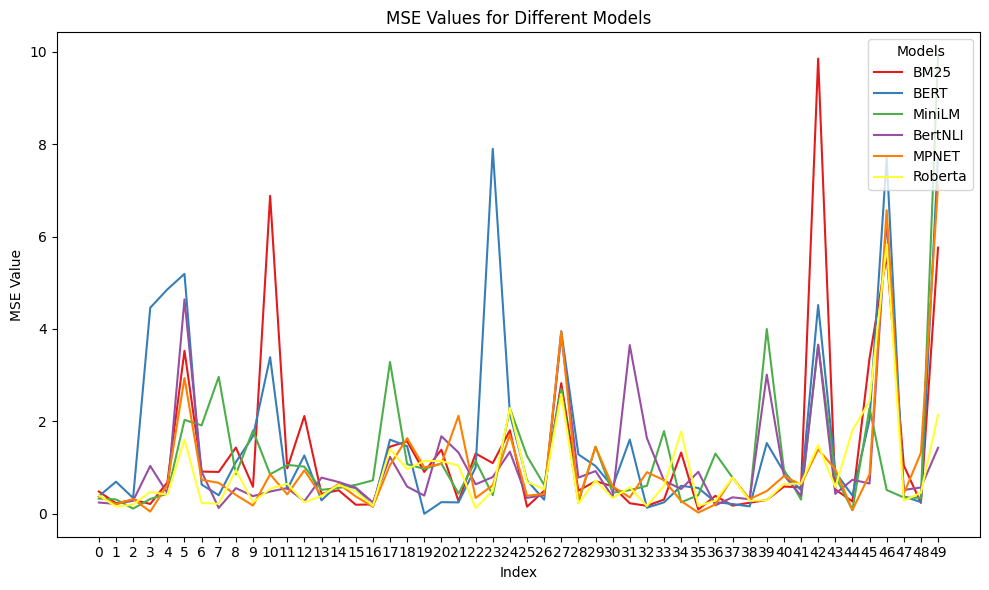
- A fixed set of 50 randomly selected reviews was used as queries.
- Models predicted the most similar hotels based on review text, evaluated using Mean Squared Error (MSE).
3.2 Models
3.2.1 Baseline: BM25
- Implemented with
rank-bm25. - Scores based on term frequency (TF), inverse document frequency (IDF), and document length.
3.2.2 BERT
- Pre-trained
bert-base-uncased. - Cosine similarity between averaged embeddings used for recommendation.
3.2.3 Sentence Transformers
Several variants tested:
- MiniLM: Lightweight and fast.
- BertNLI: Fine-tuned for natural language inference.
- MPNET: Contextually advanced.
- Roberta: Best performer for semantic similarity.
4. Results


- Roberta: Achieved the lowest average MSE (0.86), outperforming BERT and BM25.
- Sentence transformers demonstrated significant gains over the baseline.
5. Ensemble Learning
- Combined predictions from all models.
- Best-performing model per query selected based on MSE.
Example Results:
| Query ID | Best Model | Best MSE |
|---|---|---|
| 111507 | MPNET | 0.05 |
| 93517 | MiniLM | 0.11 |
| 93340 | Roberta | 0.16 |
6. Conclusion
- Transformer models (e.g., Roberta) excel in capturing semantic nuances.
- Preprocessing and embedding efficiency are critical to scalability.
- Ensemble methods further enhance recommendation accuracy.
7. Delivery
- Intermediate results (e.g., datasets, embeddings) stored to facilitate reproducibility.
- Code structured to automate retrieval of precomputed artifacts, minimizing computational overhead.
ML-Powered Suggestions
How it works:
I use a MiniLM-L6 transformer model to turn project descriptions into mathematical vectors.
By calculating the Cosine Similarity between these vectors, the model identifies semantically related work.
Analyzing project similarities...